The Name in Every Tongue: A scroll to end the argument about Jesus and/or Yeshua
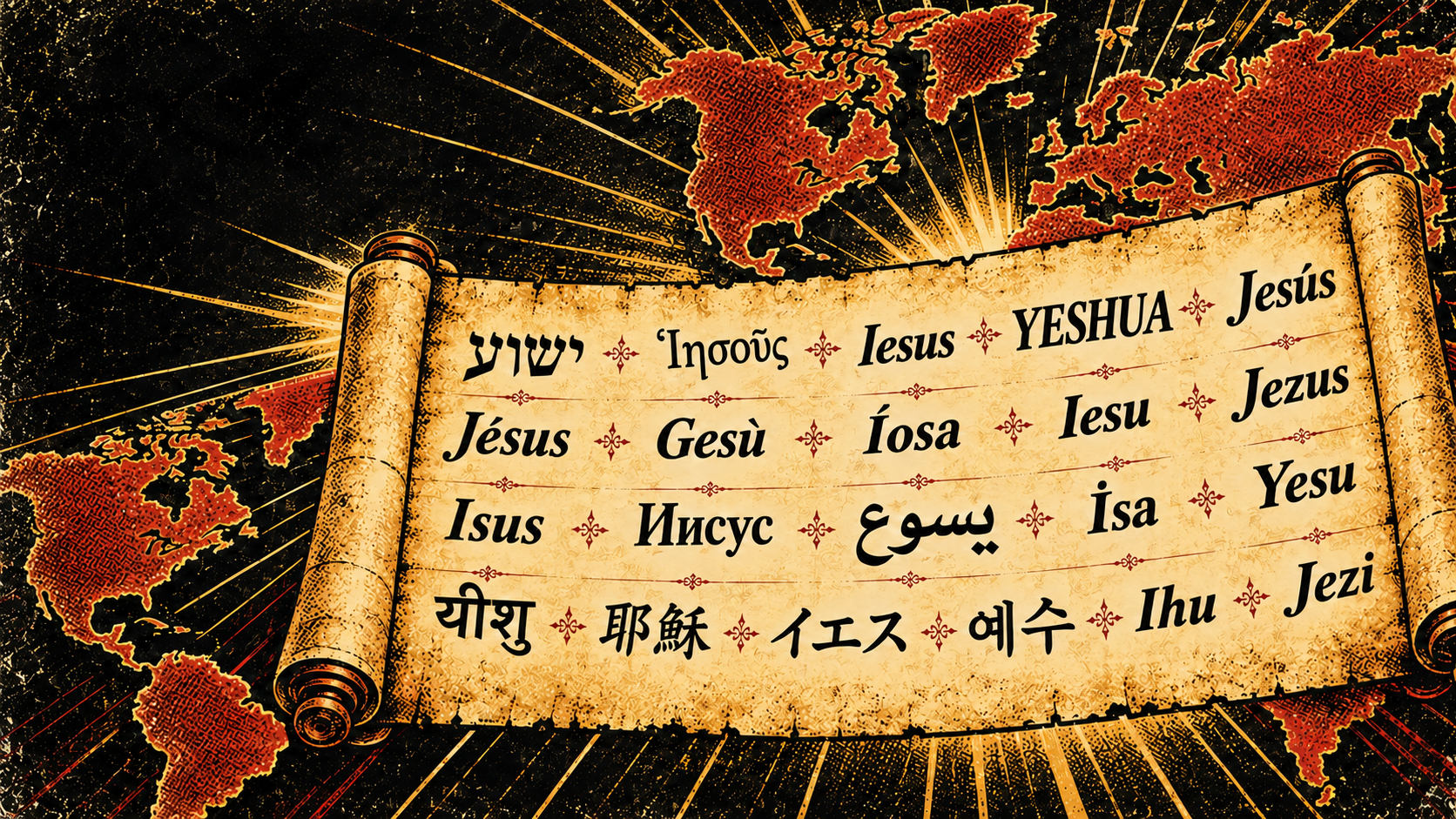
There's a teaching going around online Christian spaces right now that says the name Yeshua is not the real name of Jesus Christ. Some take it further and say it's the name of a Kabbalistic fallen angel, and that if you pray using it, you're praying to Satan.
It's wrong. Linguistically wrong, historically wrong, and spiritually barren. It produces no peace, no love, no fruit of the Spirit at all — just fear, confusion, division and people accusing each other of worshipping demons.
How Names Actually Work
Names change when they cross languages. They always have. Nobody treats this as suspicious in any other context.
Peter — the same man — is called Petros in Greek, Pierre in French, Pedro in Spanish, Pietro in Italian, Pyotr in Russian, Pétur in Icelandic, Boutros in Arabic. Nobody has ever suggested these are different people or that one of these versions is demonic.
John is Ioannes in Greek, Jean in French, Juan in Spanish, Giovanni in Italian, Johann in German, Jan in Danish, Ivan in Russian, Seán in Irish, Yoḥanan in Hebrew. Same man. Different sound systems doing what sound systems do.
It's called phonological adaptation. A name enters a new language and gets shaped by that language's sounds, spelling rules and speech patterns. It happens to every name in every language on earth. It doesn't change who the name belongs to.
The name of Jesus Christ went through exactly this process. Nothing more.
The Transmission Chain
Mary didn't call Him "Jesus." She spoke Aramaic. The name the angel gave her was Hebrew: ישוע — Yeshua. A shortened form of Yehoshua. It means "Yah saves."
It's the same name as Joshua son of Nun. It was an ordinary Jewish name in the first century — Josephus alone records at least twelve men called Yeshua, four of them high priests.
When the New Testament was written in Greek, the name had to be transliterated. Greek doesn't have a sh sound, so it became s. The final ayin dropped out. A masculine ending -ous was added, the way Greek handles male names. Result: Ἰησοῦς — Iēsous.
From Greek it went into Latin as Iesus — pronounced YEH-soos. The Vulgate carried that form through the Western church for over a thousand years.
English picked it up from Latin. Until the 1500s, English used the letter I for both the vowel and what we now write as J. The spelling was Iesus, but the I before a vowel already sounded like a J. When English typography finally split I and J into separate letters, the spelling became Jesus.
Yeshua → Iēsous → Iesus → Jesus.
No break. No substitution. No conspiracy. One name moving through languages the way every name moves through languages.
The Name in Every Tongue
Look at how His name is spoken around the world. Not one of these sounds like the English "Jesus." If only one pronunciation were the right one, then billions of believers across two thousand years have been praying to nobody. That position isn't just wrong — it's blasphemous. It puts a limit on the God who created every tongue at Babel and poured out His Spirit at Pentecost so every nation could hear in their own language.
Biblical and Historical Forms
Hebrew: ישוע — yeh-SHOO-ah (Yeshua)
Hebrew, longer form: יהושע — yeh-ho-SHOO-ah (Yehoshua)
Classical Syriac, Eastern: ܝܫܘܥ — ee-SHOH' (Ishoʿ)
Classical Syriac, Western: ܝܫܘܥ — yeh-SHOO' (Yeshuʿ)
Greek, New Testament: Ἰησοῦς — ee-eh-SOOS (Iēsous)
Latin: Iesus — YEH-soos (Classical); YEH-zoos (Ecclesiastical)
European Languages
English: Jesus — JEE-zus
Spanish: Jesús — heh-SOOS
Brazilian Portuguese: Jesus — zheh-ZOOS
European Portuguese: Jesus — zhuh-ZOOSH
French: Jésus — zhay-ZÜ
Italian: Gesù — jeh-ZOO
German: Jesus — YAY-zoos
Dutch: Jezus — YAY-züs
Danish: Jesus — YEH-soos
Norwegian: Jesus — YEH-suus
Swedish: Jesus — YEH-suss
Icelandic: Jesús — YEH-sis
Finnish: Jeesus — YEH-soos
Estonian: Jeesus — YEH-soos
Czech: Ježíš — YEH-zheesh
Slovak: Ježiš — YEH-zhish
Polish: Jezus — YEH-zoos
Croatian: Isus — EE-soos
Bosnian: Isus — EE-soos
Serbian: Исус — EE-soos
Russian: Иисус — ee-ee-SOOS
Ukrainian: Ісус — ee-SOOS
Belarusian: Ісус — ee-SOOS
Bulgarian: Исус — ee-SOOS
Romanian: Iisus — ee-SOOS
Hungarian: Jézus — YAY-zoosh
Albanian: Jezusi — yeh-ZOO-see
Basque: Jesus — YEH-soos
Galician: Xesús — sheh-SOOS
Corsican: Ghjesù — dyeh-ZOO
Irish: Íosa — EE-suh
Welsh: Iesu — YEH-see
Scottish Gaelic: Ìosa — EE-suh
African Languages
Swahili: Yesu — YEH-soo
Hausa: Yesu — YEH-soo
Yoruba: Jésù — JEH-soo
Igbo: Jisọs — JEE-saws
Zulu: uJesu — oo-JEH-soo
Chichewa: Yesu — YEH-soo
Amharic: ኢየሱስ — ee-yeh-SOOS
Tigrinya: ኢየሱስ — ee-yeh-SOOS
Middle Eastern and Asian Languages
Arabic: يسوع — ya-SOO' (Yasūʿ)
Turkish: İsa — ee-SA
Azerbaijani: İsa — ee-SA
Kazakh: Иса — ee-SA
Kyrgyz: Иса — ee-SA
Uzbek: Iso — ee-SAW
Kurdish: Îsa — EE-sah
Hindi: यीशु — YEE-shoo
Bengali: যীশু — JEE-shoo
Kannada: ಯೇಸು — YAY-soo
Gujarati: ઈસુ — EE-soo
Tamil: இயேசு — ee-YAY-soo
Mandarin Chinese: 耶穌 — yeh-SOO
Japanese: イエス — ee-EH-soo
Korean: 예수 — YEH-soo
Indonesian: Yesus — YEH-soos
Javanese: Yesus — YEH-soos
Filipino: Hesus — heh-SOOS
Burmese: ယေရှု — yay-SHOO
Khmer: យេស៊ូវ — yeh-SOO
Mongolian: Есүс — yeh-SOOS
Pacific Languages
Hawaiian: Iesu — ee-EH-soo
Māori: Ihu — EE-hoo
Indigenous Languages of the Americas
Cherokee: ᏥᏌ — TSEE-sah (Tsisa)
Quechua: Jesús — heh-SOOS
Caribbean Creoles
Haitian Creole: Jezi — zhay-ZEE
When People Say "It Doesn't Sit Right in My Spirit"
Some people hear the name Yeshua and say it feels wrong. They take that feeling as the Holy Spirit warning them.
It's not. It's familiarity bias. If you've heard "Jesus" one way your entire life — in church, in prayer, from childhood — then of course a different pronunciation feels strange. Your brain reads unfamiliar as uncomfortable, and uncomfortable as dangerous. That's a reflex, not discernment.
A Swahili believer raised on Yesu would feel the same unease the first time they heard the English JEE-zus. Does that make the English name demonic? Obviously not.
If the discomfort only fires at one linguistic variant while letting all the others pass without question, the issue isn't spiritual. It's cultural.
The Kabbalah Argument
The claim goes like this: a Kabbalistic rabbi wrote that Yeshua is the name of an entity called Metatron, therefore everyone who prays using that name is praying to a fallen angel.
Think about what that actually means. It condemns every Aramaic-speaking Christian in the Syriac church — who have used that name for nearly two thousand years. It condemns every Hebrew speaker in the first century who called on the Lord during His earthly ministry, by the name His mother gave Him. It takes one mystic's theological framework and applies it retroactively to everybody.
The logic collapses on contact. You can't take one Kabbalistic author's interpretation of a name and decide the name belongs to the occult. Occult traditions also use the word "God." Does that make "God" a demonic word?
And here's the part that should really give people pause: some of these teachers cite Blavatsky, Crowley and Kabbalistic texts as their evidence. They're using actual occult sources to warn you about the occult. Read that again.
The "Dead Language" Claim
Then there's the claim that Hebrew is a dead language, fabricated from Aramaic and magic by the Masoretes, so any Hebrew name — including Yeshua — has no real basis.
Wrong. Biblical Hebrew was in continuous liturgical and literary use for centuries. The Masoretes didn't invent it. They added vowel markings to the existing consonantal text to preserve its pronunciation. That's conservation, not fabrication.
You can't call Hebrew a dead fake language and then claim to teach the Bible — a book that was substantially written in Hebrew. The contradiction disqualifies itself.
The Real Deception
The deception here isn't in the name. It's in the debate itself.
Look at the fruit. People who use the name Yeshua get called Satan-worshippers. Anyone who pushes back gets labelled controlled opposition. Questions get deleted. Challengers get blocked. There's no peace in these spaces. No love. No patience. No gentleness. Just fear, suspicion, anger, and believers tearing each other apart.
That is a spirit of control wearing a Christian mask.
And the timing matters. This campaign has surged at the exact moment more people are waking up, asking real questions about their faith, and looking for a direct relationship with the Lord outside of institutional gatekeeping. That's not a coincidence.
Any movement that drives people away from the original name of their Saviour, makes them doubt whether He even hears them, and leaves nothing behind but confusion and fear — that movement does not come from God.
Test it by its fruit. There is none.
Conclusion
Yeshua, Iēsous, Iesus, Isho, Yesu, Hesus, Jezus, Jesus — same name, carried across languages by the same process that governs every name in every language in human history.
He knows who you mean.
He has always known.
"After this I looked, and there before me was a great multitude that no one could count, from every nation, tribe, people and language, standing before the throne and before the Lamb." — Revelation 7:9
Every tongue. Not one tongue. Every tongue.
In Jesus´name, it is done. Amen